
Three facts get a first game started: the board is 19×19 intersections; Black places one stone, then both sides drop exactly two stones a turn; six or more in a row, column, or diagonal wins at once. The two stones need not be adjacent. Stones never move and are never captured.
Board and opening
Play is on a 19×19 grid of intersections. There are no captures, forbidden patterns, or handicaps. Black moves first with a single stone; every later turn must place exactly two stones. That rhythm was designed to cancel Gomoku’s first-move advantage: after each full turn you have netted one extra stone on the board.
Completing a turn
Tap an empty intersection to place a stone. The opening move submits after one stone. After that, the first tap is pending and the second tap completes the turn. Tapping the pending stone again cancels it before the second stone is placed. The two stones may sit anywhere empty; they do not have to touch. A turn is not finished until the required number of stones is confirmed.
A first game to follow
Place the opening stone near the center; it does not need to be the exact center. On every later turn, pause before placing: use one stone to extend one of your lines or stop an opponent’s line, then give the second stone a different job. This keeps a new player from spending both stones on one cramped idea.
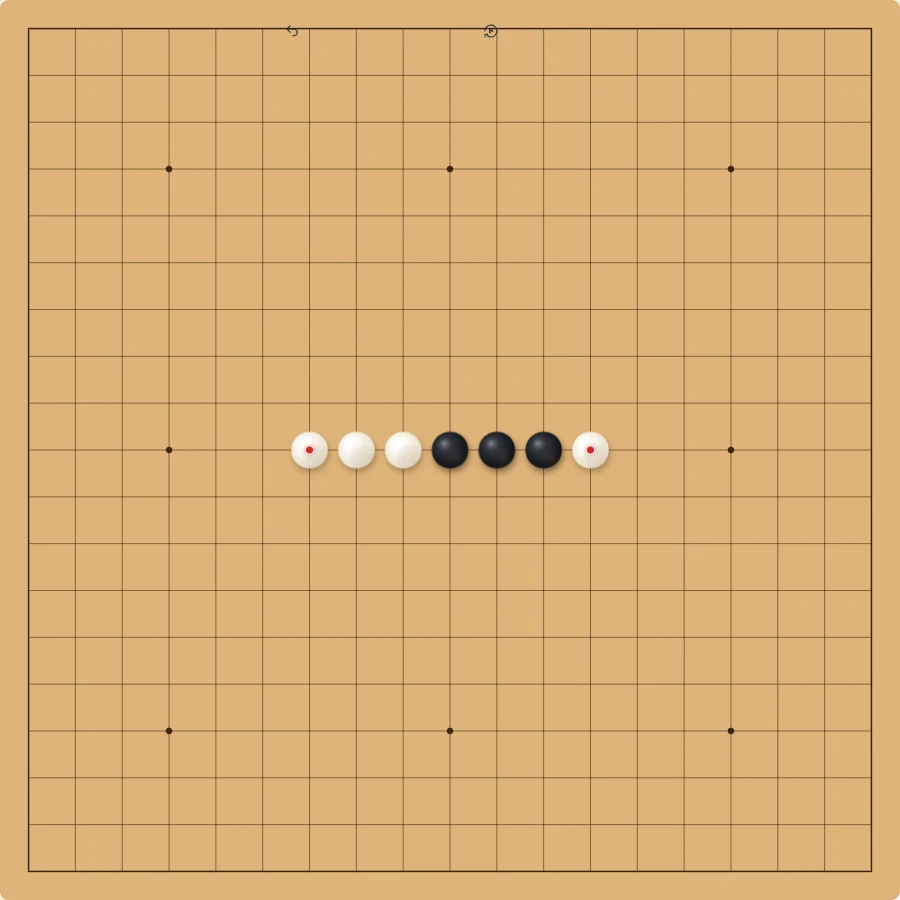
For example, if an opponent has four stones in a row with both ends open, blocking one end and attacking elsewhere is unsafe: their next two stones can grow from the other end. Use your pair to cover both ends first. Conversely, when you have three stones, extending two different directions is usually harder to stop than pushing both stones into one line.
Winning and draws
Six or more stones in a row, column, or diagonal wins immediately; seven and eight also count. Stones stay where they land. If the 19×19 board fills without six in a row, this site scores a draw. Online rooms may also agree a draw before that.
Illegal moves
These moves are illegal: occupying a filled intersection; placing only one stone, or more than two, after the opening; playing while the other side still has a pending turn; moving or removing a stone already on the board. This site has no overline ban: more than six in a line still wins.
How the modes differ
All three modes use the same movement and ending rules. Play vs AI offers hints, undo, and replay. Same-device play offers undo and replay, but no hints. Online rooms sync both sides, allow resign and draw offers, and do not support one-sided undo.
For pairing stones, crossing points, and split defense, read the Connect6 strategy guide.
FAQ
Why two stones each turn?
Fairness. Gomoku’s first move is mathematically strong. Connect6’s opening — one stone, then two each — means you always finish a turn one stone ahead of the opponent, which cancels that advantage.
Must the two stones be adjacent?
No. They may land on any two empty intersections: side by side on one line, or one attacking and one defending at opposite ends of the board. Split plays are often stronger.
Does more than six in a row still win?
Yes. This site has no overline ban. Six or more in a row, column, or diagonal wins at once.
How is Connect6 different from Gomoku?
Gomoku places one stone a turn and wins with five. Connect6 places one stone first, then two a turn, and wins with six, on a 19×19 board. The rules stay simple, but each turn changes two points, so reading the board is harder.
What happens if the board fills?
If every intersection is occupied and nobody has six in a row, this site scores a draw. Online rooms can also offer a draw before that.
Where should I place the first stone?
Start near the center. It leaves room in horizontal, vertical, and both diagonal directions, so it is the simplest place to learn from. Avoid an edge or corner opening: it loses a direction and can be sealed with one stone.
