
Connect6 is lost more often by missing a defense than by failing to push one extra stone. The opponent still has two stones next turn, so a single open three is usually stoppable. Ask what each of this turn’s stones is for, then use hint, undo, and replay to try another pair. If the rules are still new, start with the Connect6 rules.
Place stones in pairs
The strongest turn rarely dumps both stones on the same line. One stone stretches your own connection; the other blocks a line that is already forming. If both stones chase one threat, two replies can take it apart.
Crossing points
Watch intersections that touch two lines at once. After that stone lands, the next two stones can push both directions, and two replies may not cover both. Open near the center rather than packing stones into a corner.
Split the defense
Facing two threats, answering one each is usually better than stacking both replies on one line. The opponent also changes two points a turn; the line you skip can become six next move. When unsure, spend at least one of the two stones on defense.
Check before placing
Look at the opponent before chasing your own line. Ask three questions in order: do they have an open end on a five-stone line; can their next pair create two threats; and if both of my stones attack, can they make six next turn? If the first answer is yes, spend at least one stone blocking it.
Then check whether your pair works together. A good pair need not touch; it leaves two useful places to extend next turn. After placing, switch perspective and identify the opponent’s two strongest points. If you can see one immediately, deal with it on your next turn.
Leave room
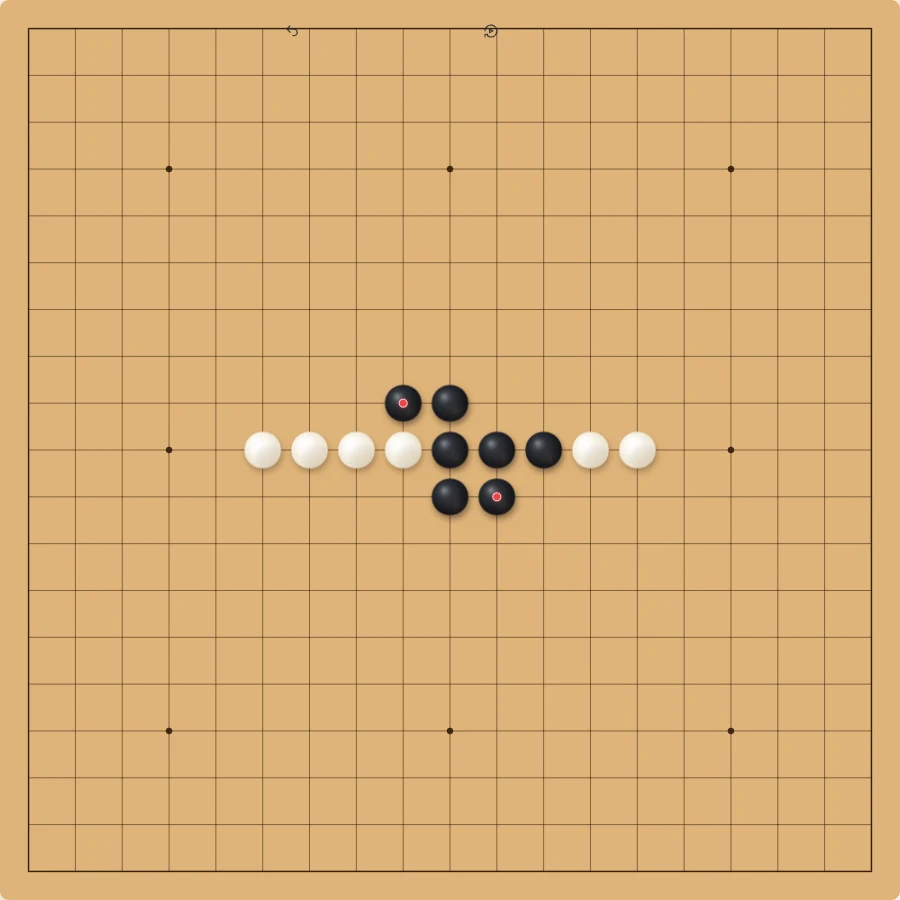
Nineteen lines are large enough for two threats at once. An opening cramped onto one short line lets one stone block your only exit. Scatter early so the second player has room to split, and so you have a second line to grow.
Practice one idea
Return to Play vs AI and watch one habit: hunt crossing points, or always split two threats. Hint returns the one or two stones this turn should drop; undo first clears a pending tap, then the whole turn. Comparing two pairs on the same position teaches more than playing many games in a row.
FAQ
What should a beginner watch first?
Defense. Ignoring a forming line loses quickly because the opponent adds two more stones next turn. When unsure, spend at least one of the two stones on defense.
Why isn’t a single open three enough?
The opponent has two stones to answer it. Winning attacks usually stack two threats so each reply can cover only one.
Does hint return one stone or two?
It returns however many stones this turn must place: one on the opening move, two afterward. The search runs on this device and is not a proof of the best move.
What if I tap the first stone by mistake?
Tap it again before the second stone to cancel. The turn submits only after both stones are placed. Same-device and AI play can also undo a finished turn.
Should my opening pair be close together?
Not necessarily. Nearby stones are easy to read, but they are also easy for the opponent to contain with their pair. As a beginner, put one stone near your main line and keep the other a few points away on a second direction, so both lines can still grow.
